Week 1 - Back to Reality

Welcome to the first blog of my capstone project!! 😀
Overview
Stream: Business (Diversity, Equity, and Inclusion) Partner: Diversity Works NZ
Brief Aim: Design to promote DEI in workplaces and businesses
Problem Space: Food allergies - I'm allergic to nuts, eggs, seafood, dairy, kiwifruit, and eggplant
Last semester, I created my HMW statement:
How might we design a product that can test food for specific allergens for customers of hospitality businesses to foster a safer and more secure experience and increase inclusivity and equity for consumers with allergies?

To guide me through this semester, I will conduct this design process using The Field Guide to Human-Centred Design as my methodology, which includes three phases: Inspiration, Ideation, and Implementation (IDEO.org, 2015).
Description
Flashback to the end of semester 1, we had our final presentations where we gave an overview of our capstone idea. Although I got good feedback for both the presentation and report, this project continued to haunt me at the back of my mind during the entire break.
What is the current status? You tell me. Undefined.
I guess I'm currently in the inspiration phase as I've done previous research and looked at my design challenge for the research proposal.
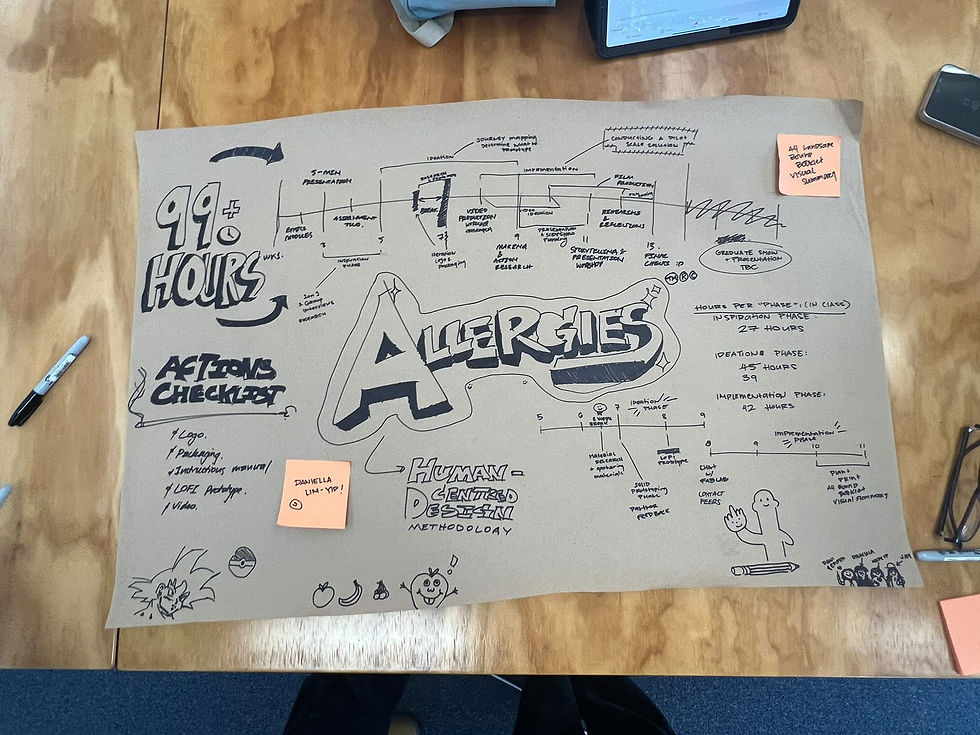
Now that I've achieved two significant milestones from last semester, it's time to map out a timeline and refine my goals.
Now it's week 1 and we're back to early mornings, yay. For DES301, we got into groups of four, chose one of our projects, and created a semester-long timeline. This week has gone by so fast, and I've done nothing. Now, I'm left to marinate in my thoughts for how much we have to do. Mmmm 😋
Feelings
When I found out I was presenting first, I was about to throw hands - felt like I had the worst luck. Luckily, I went second as someone had to leave early. Regardless, it was still daunting. I was confident with my content, but no matter how much I know a topic, I always get nervous and need more confidence in my communication.
I realised how important it was to create the timeline because it made me see how much there is to do. The extensive workload is starting to hit me.
At this stage, I've never felt so lost about something I was so sure about. I'm beginning to doubt myself because my mind is so set on my current idea that it's restricting anything else.
On the bright side, I remember yonks before I even started university that I wanted to do my capstone on food allergies. I'm happy I could do a topic I'm passionate about, as it has validated my thoughts and feelings about my struggles.
Evaluation
My speech was clear for the presentation, and I had good word choices as I knew my topic well and was confident in what I wanted to say. I was also under the time limit because I spoke too fast.
For my research proposal, I received the following constructive feedback:
The timeline being a group exercise was helpful as we could bounce off and validate each other's ideas. My project was used because I had the clearest vision for it, so they did me a favour, but it also meant they could use mine as a blueprint, so you're welcome guys 😌

As I'm still in the inspiration phase, I'm using Miro, Notion, and ChatGPT. Miro has a range of templates to follow, and it's perfect for brainstorming and collaboration. I'm using it for my capstone and with my group for DES301 so we can keep each other accountable and help each other throughout the semester. Currently, I use Notion to make my to-do lists as it's my personal workspace. For ChatGPT, I like to enter my assignment briefs and the criteria. This way, it generates more questions that can help me refine my writing and break down assignments to give me more specific to-do lists, ensuring that I meet the criteria. The only downside with this tool is that it's really slow whenever I use it.

This semester will come with a lot of challenges. I'm only taking the capstone, so I'll be in a different mindset because I usually take business and design papers each semester due to my conjoint degree. During the break and last semester, I was too familiar with all-nighters, and my sleep schedule was so bad that I'd be sleeping at 4am. A lot of this is due to my tendency to be a perfectionist and overthink, which makes me procrastinate and prevents me from starting things.
Analysis
The outcome of my report and presentation was pretty decent due to how structured and organised I like things to be. In hindsight, however, I wasn't prepared enough for my presentation, and I began writing the report very late as I got stuck in a rabbit hole during the research stage of my design proposal.

Upon using The Field Guide to Human-Centred Design, I noticed both strengths and weaknesses. In the Ideation Phase, one method is a co-creation session (IDEO.org, 2015), employing participants to become designers and not just interviewees. This is essential for my project as people with allergies aren't the only people affected. By collaborating with various stakeholders, my final solution will be influenced by diverse perspectives. However, this guide is also outdated which means that it may not reflect best practices, as the design landscape is constantly changing. To aid this, I can research into more current tools and methods and integrate them into my current design process.
Conclusion
I've accepted that I need to work on my presentation skills, especially as we're having weekly check-ins in front of our stream. A few other skills that I need to work on are being more decisive (indecisiveness is a crippling trait of mine) and knowing my limits, especially when it comes to the long and stressful phases of my design process.
Over time, I'm slowly understanding what methods work for me in terms of how I work. I like to cover every checkpoint because if I don't have a straightforward process, I can't start (which, in a way, is also a bad thing). Despite being a planner, I always underestimate how long it takes to do things. I work until the last minute because there's always more that can be done to improve; in saying that, I need to know when what I have, is enough.
Recently, I heard someone say, "If you're not sure what you're capable of, you're capable of anything", which resonated with me. I tend to fear starting things because of the unknown or the idea of change, but I've learned that change is essential when designing.
Action Plan
I've started to see Instagram posts about presentation skills, so that's a sign that I should practise them.
With the huge workload, I need to refine my timeline by adding more specific subtasks.
Look over all the assignments and slides to make a to-do list and wrap my head around everything.
I've made a bet with my sister that we both have to sleep before 11pm, paying each other $5 if we sleep at 11pm and $1 for every hour after. My bank account will be in the negatives by the end of my capstone.
References
IDEO.org. (2015). The Field Guide to Human-Centred Design. Design Kit. https://www.designkit.org/resources/1.html
Comments